Beginning with Recast Software Version 5.9.2502.2105, your Recast Management Server retrieves user and device data from your Configuration Manager and Active Directory service connections according to a set discovery sync schedule.
View Discovery Sync Details
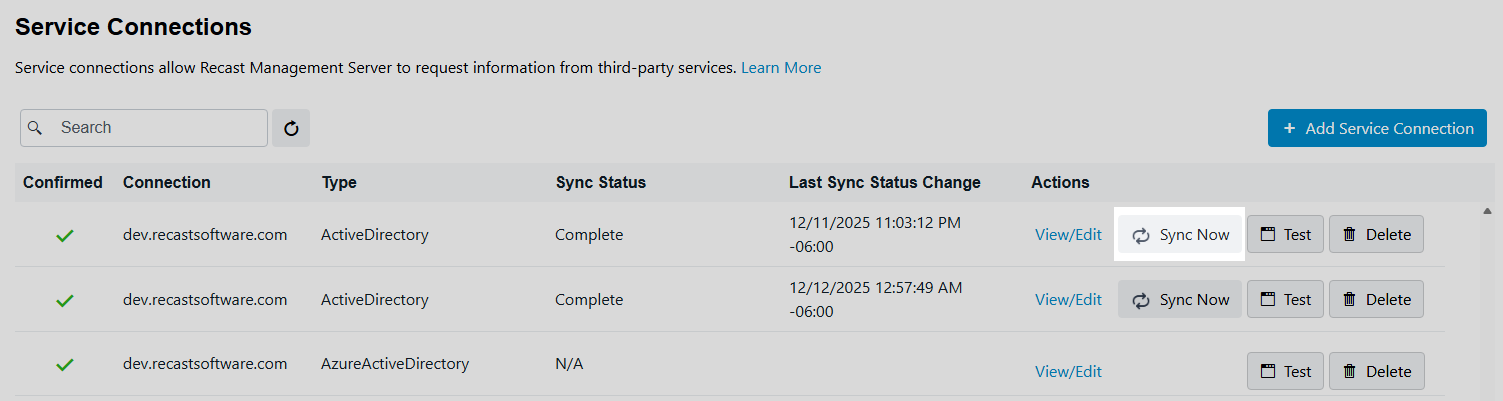
The RMS Service Connections page displays the current Sync Status and the Last Sync Status Change. For specifics, see View Service Connections.
Edit Discovery Sync Schedule
Your Recast Management Server automatically creates a scheduled task to retrieve data from each ConfigMgr and AD service connection every 24 hours. By default, synchronization occurs nightly at a random time between 1am and 3am at the server's local time.
If you want to manually adjust the timing of scheduled tasks, please request assistance from our Customer Experience team.
Initiate a Discovery Sync
It's essential that device and user data be up-to-date in your Recast Management Server before adding a user/group limiting rule or route limiting rule as data that does not match in RMS and the service connection cannot be saved. Instead of waiting for the scheduled discovery sync to run, you can manually trigger data synchronization.
To manually initiate a discovery sync on the Service Connections page, click Sync Now and confirm the action. The service connection's Sync Status will change to 'In Progress'.
NOTES:
- In larger environments, a discovery sync can take 15 minutes or longer to complete.
- You cannot cancel a discovery sync once it is in progress.
- Running a discovery sync during working hours can impact individuals using the system.
- If you plan to trigger discovery syncs for multiple service connections, we recommend doing so consecutively rather than concurrently to avoid memory errors.